Every call your clinic misses is an appointment walking away.
Agendavia answers the phone 24/7, looks at your clinic's real schedule, offers slots that actually exist and books the appointment into your own calendar. Then it shows you, in dollars, what it recovered. Made for clinics, dental offices and medical practices — not a generic bot.
Press play and the conversation writes itself as it goes. Recorded in Spanish — English voices available.
Buenas tardes, le atiende el asistente virtual con inteligencia artificial de Clínica San Martín. Le ayudo con su cita. Si prefiere hablar con una persona, dígamelo en cualquier momento. ¿En qué le puedo ayudar?“Good afternoon, this is the AI assistant…” — it identifies itself as AI on every call
Hola, buenas tardes. Quería agendar una cita para la revisión.“I’d like to book a check-up.”
Con gusto. Para localizar su expediente, ¿me regala su nombre completo y su fecha de nacimiento?Two identifiers — a phone number is never enough
Jorge Alberto Ramírez, 12 de marzo del 75.
Gracias, señor Ramírez. Tengo el martes 25 a las diez y media con el doctor Sandoval, o el jueves 27 a las cinco de la tarde con la doctora Beltrán. ¿Cuál le acomoda mejor?Real slots from the real schedule, with the visit length applied
El jueves por la tarde está bien.
Listo. Queda agendado el jueves 27 a las cinco de la tarde con la doctora Beltrán. Le mando la confirmación por mensaje a este mismo número. ¿Le puedo ayudar en algo más?Written into the clinic’s own calendar
No, muchas gracias.
Que tenga muy buena tarde.
Connects to the practice software you already use. No system change, no new phone number.
Built for clinics, not adapted from a call center.
A medical appointment is health data. That changes where the servers can be, which contract has to be signed and what the assistant may answer if someone mentions a symptom. Agendavia was built from those four answers, not the other way round.
The four questions almost nobody asks before buying an AI answering service
Nobody writes down the calls they miss. That's why the leak never shows up.
Lunch hour, evenings, weekends, two patients at the desk while the phone rings. A front-desk employee covers about 19% of the hours in a year. A patient who can't reach you doesn't leave a message — they call the next clinic on the list.
It connects to the schedule you already use. It's not a pretty-voiced answering machine.
It rings, it answers
After hours, always. During office hours, only if nobody picks up in four rings or the line is busy. You control when it steps in through your own call forwarding — and you can change it any time.
It reads your real schedule
Available slots by provider, room and visit type. It never offers a slot that doesn't exist and never books two patients at the same time.
It knows who's calling
Finds the patient record by phone number and verifies identity with a second identifier before reading anything out loud. New patients get registered on the spot.
It shows you the money
A monthly report: calls answered, appointments booked, and the revenue they add up to. Without that report this would just be another expense.
It connects to yours and writes into the diary you already use.
You don’t switch systems, you don’t migrate anything and you don’t change your number. The assistant reads the slots that genuinely exist and puts the appointment where your team will see it in the morning.
- DriCloud, XDentalCloud and AgendaPro are already connected.
- It only offers slots that genuinely exist, by practitioner, room and appointment type.
- The appointment it creates is an ordinary one in your diary, so the reminders you already send go out as usual.
- If your software has an open API, we build the connector for you.
Google Calendar or Outlook is enough. And we give you what’s missing.
A calendar stores appointments, not people. So anyone working this way can’t recognise a caller by their number or look one up without digging through their phone. That part is on us.
- Works with Google Calendar and Microsoft Outlook. Nothing else needed.
- We give you the patient records you don’t have today, included in every plan at no extra charge. They fill themselves with every call, and you read and correct them from your dashboard.
- The first time it takes their name and creates the record. From the second call it recognises them by their number, just like practice software would.
- If you want, it sends the appointment reminder by email or SMS. Email is included; SMS is charged by the carrier and itemised on your invoice.
One phone line, three different problems.
A missed call doesn’t hurt everyone the same way. It hurts three people at once, for three different reasons.
No more choosing between the patient in front of you and the one on the phone.
The phone rings while you are helping an eighty-year-old who came in to move his appointment. One of them always loses: either you interrupt him, or you let it ring.
Your front desk makes that call twenty times a day. With Agendavia it stops making it — the phone answers itself and your team stays with the person in front of them.
See how the work is split →
Missed calls never show up in any report.
There is no line in your accounts that reads “appointments that never happened”. That is why the leak stays invisible, and why nobody fixes it.
Every month you get the number: calls answered outside opening hours, appointments that came out of them, and what they are worth. If the report doesn’t justify it, you don’t renew.
See what a plan costs against what you lose →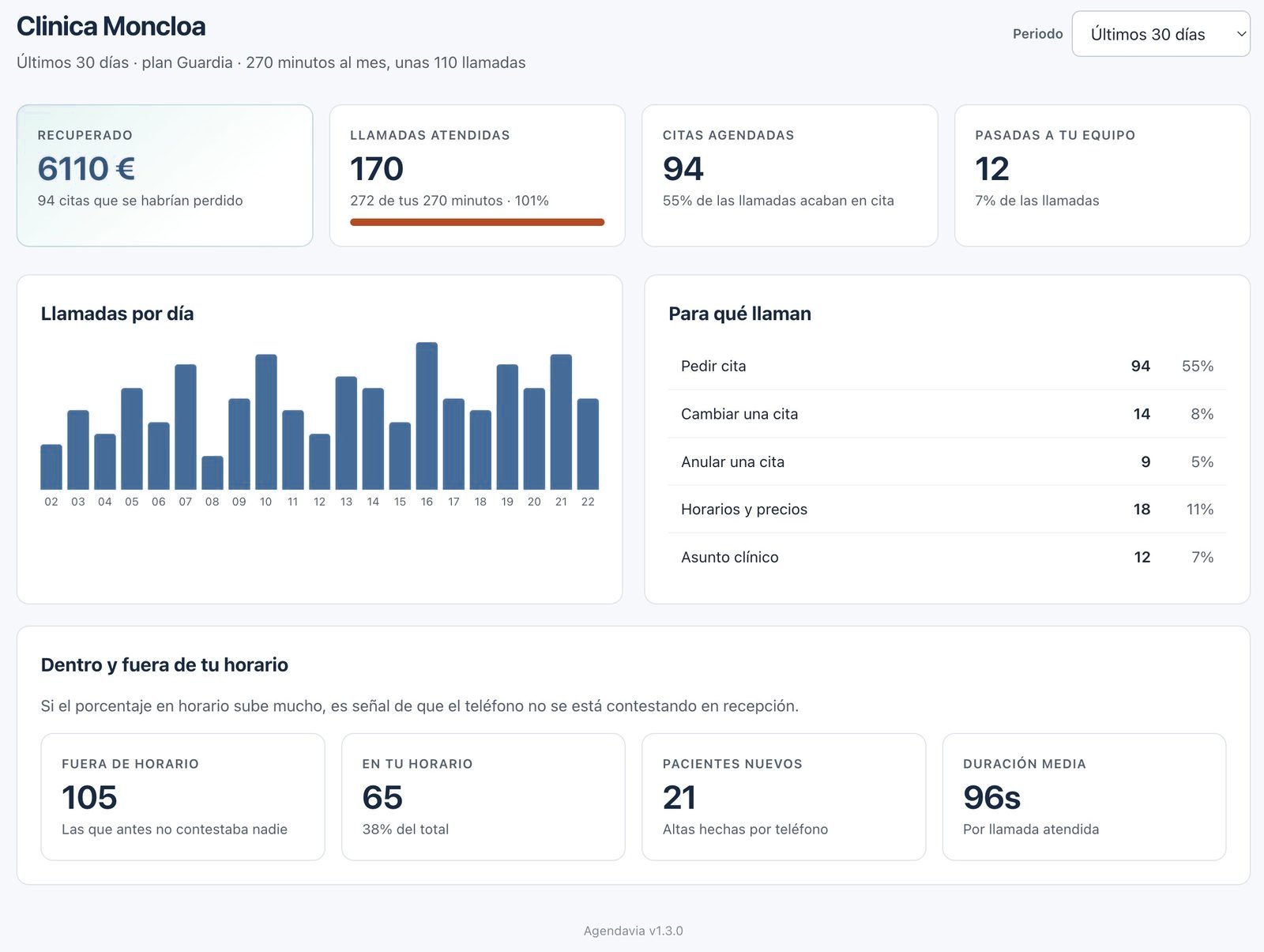
Somebody picks up, first time.
The worst part of calling a clinic isn’t being put on hold. It’s nobody answering at all. You call in a hurry, or worried, and it rings until you hang up.
That is the moment a patient gets angry, leaves a one-star review, tells whoever asks, and calls the practice down the road. All of it starts with a phone nobody picked up.
How it introduces itself to your patients →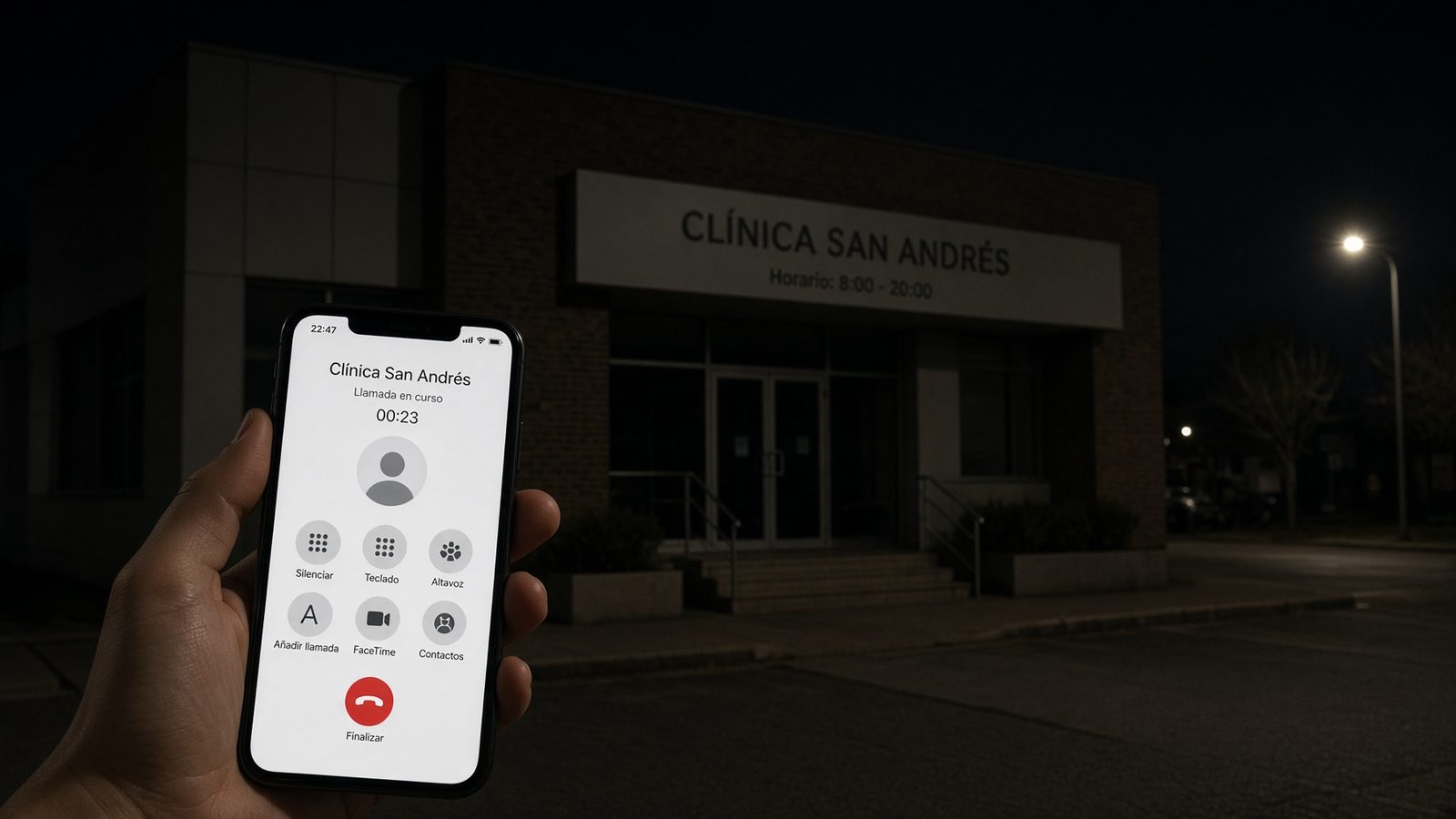
Everything a receptionist does with the schedule. Nothing a clinician does.
It books, reschedules and cancels appointments. It answers hours, address, parking and insurance questions. It registers new patients. And the moment a caller mentions pain, symptoms or anything clinical, it stops and transfers to your staff. It never gives medical advice and never performs triage. That line is hard-coded, not configurable.
The line is there to keep the liability off your practice, not off ours. When an automated system assesses a symptom or sorts patients by severity, three things happen at once: it stops being a scheduling tool and becomes a medical device, which is an FDA question, not a software question; it starts using protected health information for a purpose your patient never authorized and that is nowhere in your notice of privacy practices; and it makes a clinical judgment about a person with no licensed clinician behind it. In all three, the party answering for it is the practice — you are the covered entity, we are only the business associate. So the assistant does not go near it, and that is written into the agreement you sign.
The only question that matters is whether it sounds right. Judge for yourself.
Real calls from the system, unedited. Recorded in Spanish, which is where the service runs today; English voices are available and sound the same way.
A patient who already exists
Introduces itself as an AI, finds the record, verifies identity and leaves the appointment booked. One minute.
Moving an appointment without losing it
Finds the appointment, offers alternatives, and only releases the old slot once the new one is confirmed.
Same call, different voice
Mexican Spanish. For clinics in Latin America we use each country’s own variant, not a Spanish one.
A clinical question
The patient asks whether it’s serious. Listen to what happens: it stops and hands the call to a person. No opinion, no reassurance, nothing added.
One monthly fee. Your minutes included.
Every plan answers 24/7, every day of the year. Plans differ in providers and minutes of conversation. Go over one month? Extra minutes are $0.40 each, itemized on your invoice. We warn you at 80% — no surprises, ever.
Solo
You practice on your own or run a small office.
- One provider
- 180 minutes ≈ 70 calls
- Booking, rescheduling, cancellations
- Monthly revenue report
Front Desk
A small clinic with daytime reception.
- Up to 3 providers
- 270 minutes ≈ 110 calls
- Everything in Solo
Full Coverage
The typical clinic: several providers, real phone volume.
- Up to 6 providers
- 550 minutes ≈ 220 calls
- Automatic waitlist
- Custom call script
Enterprise
Multiple locations, many specialties or high volume.
- Unlimited providers
- 950 minutes ≈ 380 calls
- Priority support
Prices before tax. No lock-in. Free account with 30 minutes included.
Compliance isn't a page on our website. It's the architecture.
A generic voice bot is not designed for health data — and the clinic, not the vendor, answers to regulators. Agendavia was built the other way around: the assistant identifies itself as AI on every call, verifies patient identity with two identifiers before reading anything, only touches scheduling data — never medical records — and transfers anything clinical to a human, always.
United States: we operate as your business associate and sign a BAA. Our voice, transcription and hosting chain is being finalized for HIPAA-covered workloads — we'll tell you in writing exactly what's signed and what's pending before you commit.
Latin America: we work under each country's data-protection law — Mexico's LFPDPPP, Colombia's Ley 1581, Chile's Ley 21.719 among others — with a signed data-processing agreement adapted to your jurisdiction.
Spain and the EU: processing runs entirely in the EU under GDPR, with an art. 28 processor agreement and a published sub-processor list. The full security page →
An answering machine with a pleasant voice is not the same thing.
| AI answering machine | Agendavia | |
|---|---|---|
| Always answers the phone | Yes | Yes |
| Goes into your schedule and books | No, takes a message | Yes, written into your software |
| Knows which slots really exist | No | By practitioner, room and appointment type |
| Verifies the patient’s identity | No | Two details, never the number alone |
| Fills the gap left by a cancellation | No | Offers it to your waiting list on its own |
| Tells you what it recovered | No | Monthly report, appointment by appointment |
| Conversation processed in the EU only | Rarely | Always, contractually |
| Protocol for anything clinical | Improvises | Stops and hands over to a person |
Questions we get asked
Does it replace my receptionist?
Does it work with my practice management software?
Does it give medical advice or assess symptoms?
Where is my patients’ data processed?
Are calls recorded?
Do I have to change my phone number?
Can it remind my patients about their appointment?
How long until it is running?
The fastest way to judge it is to hear it.
Open a free account, connect your calendar and call your own assistant. 30 minutes on us.
Create my free account